
 0
0
 0
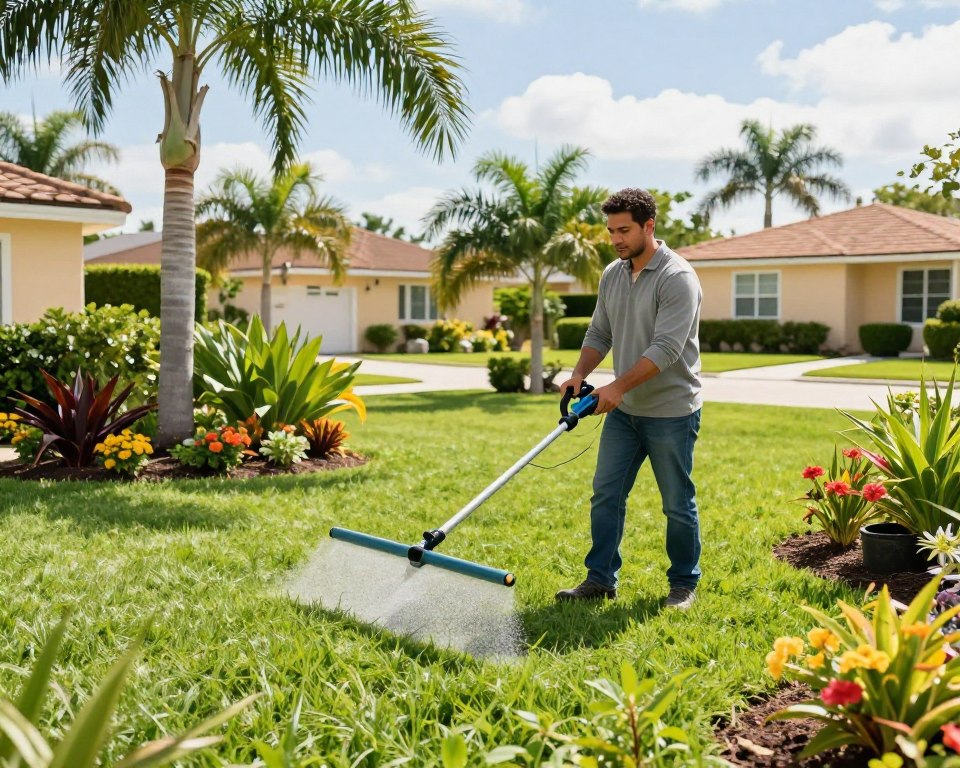
0 When to fertilize lawn in south florida matters more than the date on a calendar; watch soil warmth and new growth instead. Feel the turf green up, see blades thicken, and note more frequent mowing as clear signs that roots will absorb nutrients well.
Start with spring green-up when soil reaches about 65°F, often late March or April, then plan an application before the heavy rains of May. Hold off during steady downpours and avoid heavy feeding in mid-summer when stress and runoff risk rise.
Quick checks: measure soil temperature, watch for new shoots, and follow local rules and UF/IFAS nitrogen limits to protect waterways and reduce disease pressure.
Key Takeaways
- Use active growth and soil temps, not only dates, to decide timing.
- Early spring green-up and pre-rain spring are prime windows.
- Exercise caution mid-summer; avoid applying before heavy storms.
- Follow UF/IFAS rules, measure area, and limit nitrogen per guidance.
- Proper timing prevents burn spots, weeds, and protects storm drains.
Best time to fertilize in South Florida based on soil temperature and green-up
A simple trigger is soil near 65°F paired with visible green-up of turf. That signal shows roots and shoots are actively using nitrogen rather than holding it in the ground.
Homeowners without a thermometer can watch for fresh shoots and more frequent mowing. This visible change is a practical cue during spring and late spring when days lengthen.
Warm-season grasses respond best when fed during steady growth. Proper timing supports color and density and avoids pushing weak, disease-prone shoots.
- Plan an application before heavy May rains to cut nutrient loss through sandy soils.
- Apply only while turf is actively growing and you can water it in lightly afterward.
- Skip any feed if a major storm is likely within 24 hours.
| Trigger | Why it matters | Recommended action |
|---|---|---|
| Soil ~65°F | Roots uptake nutrients actively | Start first application |
| Visible green-up | Good for owners without tools | Apply lightly and monitor growth |
| Late spring surge | Higher uptake reduces waste | Use slow-release products when possible |
South Florida climate factors that change your lawn fertilization timing
The region’s climate drives the main risk: heavy rains can move nutrients below roots or into storm drains. That makes scheduling more important than product strength alone.
Wet season vs. dry season
During the wet season, strong downpours often carry fertilizer off the target zone. This causes wasted product, patchy growth, and pollution.
In the dry season, leaching drops. But grass may slow if irrigation is limited. Apply only when grass shows active growth.
Mild winters and near year-round growth
Warm winters mean turf rarely fully stops growing. Still, growth slows enough that heavy nitrogen is usually unnecessary year-round.
Why timing matters as much as product type
Even slow-release fertilizer underperforms if grass is dormant. Match applications to active uptake for steady, manageable results.
- Risk: Over-applying before storms = uneven growth and runoff.
- Benefit: Proper timing reduces waste and protects waterways.
| Condition | Effect | Action |
|---|---|---|
| Heavy rain | Nutrient loss | Avoid applications near storms |
| Dry spell | Slow growth | Apply only with active shoot growth |
| Mild winter | Low but steady uptake | Use light feeds, not heavy rates |
Note that summer often aligns with peak rainfall and highest runoff risk. This sets up the simple seasonal schedule that follows.
when to fertilize lawn in south florida with a simple seasonal schedule
Divide the year into four feeding windows so each application matches active growth and weather. This simple schedule helps homeowners pick the right time and avoid heavy-rain losses.
Early spring: January–March
Use this window for a first, light application as temperatures rise and shoots begin steady growth. Adjust for grass type and local rules.
Late spring to early summer: April–June
This is the main period. Warm-season turf absorbs nutrients best now, so plan one steady application before the heavy May rains when possible.
Mid-summer caution: July–September
Limit applications during peak rainfall. If you apply, use slow-release products and avoid days with forecasted storms.
Fall and early winter: October–December
Finish with a lighter feed to maintain density and stress resistance as growth slows. Do not stack products or chase color during wet weeks.
- Quick tips: space applications, follow UF/IFAS limits, and check local ordinances.
- Pick the current month and follow the corresponding step above for the safest next action.
| Season | Action | Risk |
|---|---|---|
| Jan–Mar | Light starter application | Low if timed with growth |
| Apr–Jun | Main application | Moderate if rains follow |
| Jul–Sep | Limit or pause | High runoff risk |
Match fertilization schedule to your grass type and growing season
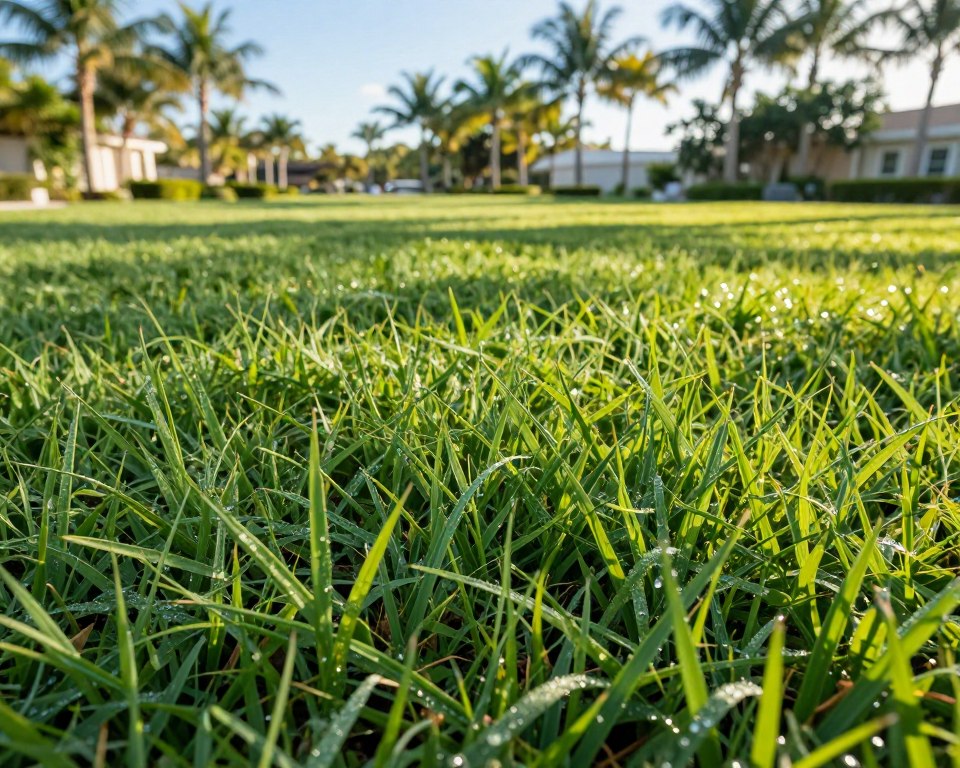
Different warm-season grasses need different pacing for nutrient boosts during their growing season. Identifying the correct grass type helps pick a schedule that fits growth, mowing, and traffic patterns.
St. Augustinegrass timing and common care considerations
St. Augustine prefers steady feeding during active growth and routine mowing. Too much nitrogen during very wet stretches raises disease and insect pressure. Scale applications back on soggy weeks.
Bermudagrass timing for high-sun, high-traffic lawns
Bermudagrass thrives in full sun and handles heavy use. It often needs a stronger schedule during peak growth, especially late spring and early summer. Use slow-release products when traffic and heat are high.
Zoysiagrass timing for balanced sun/shade lawns
Zoysiagrass builds dense turf and responds well to steady, moderate feeding. Keep rates conservative so density grows without excess top growth that invites pests.
Centipedegrass and bahiagrass timing for lower-input lawns
Centipedegrass and bahiagrass suit lower-input care. They usually need fewer applications. Overloading these species causes weak spots and more mowing.
- Identify grass type: tailor frequency and amounts.
- Match growth: apply only when shoots are active and rain risk is low.
- Refine: use soil tests and follow local ordinance guidance for best results.
| Species | Use | Feeding approach |
|---|---|---|
| St. Augustine | Shaded, residential | Steady, moderate rates |
| Bermudagrass | Sports, high traffic | Higher demand in peak growth |
| Zoysiagrass | Balanced sun/shade | Moderate, steady feeding |
| Centipede & Bahiagrass | Low-input yards | Minimal, occasional applications |
Soil testing before you apply fertilizer to avoid guesswork
Testing your soil removes guesswork and keeps nutrients targeted where they help most. A soil test tells homeowners what the ground actually needs. That prevents over-application and reduces runoff risk.
How to collect samples and use Extension results
Follow these simple steps for a reliable test:
- Take 6–10 small plugs from random spots across the yard using a trowel or soil probe.
- Remove grass thatch, combine the plugs in a clean bucket, and mix thoroughly.
- Place a mixed sample in the lab bag prescribed by your county Extension office and submit it per their instructions.
What results usually guide Florida yards
Reports focus on pH and key nutrient levels. pH affects how well grass absorbs nutrients. Nutrient readings show whether nitrogen, phosphorus, or other elements are low.
Phosphorus: when it is unnecessary and when to confirm a deficiency
Many soils already contain enough phosphorus. Adding extra often does not help and may increase runoff. Only apply phosphorus after a lab result shows a deficiency.
- Practical example: visual yellowing alone is not proof of low phosphorus—confirm with a test.
- Use Extension guidance to interpret the report and pick the right fertilizer analysis.
- Test results can shift a plan toward lighter feeds for low-input turf or a targeted schedule for higher-maintenance grass.
For details on watering after applications and scheduling tips, see this brief guide on how long to water grass.
| Step | Why it matters | Action |
|---|---|---|
| Soil test | Reveals true nutrient levels | Submit mixed sample to Extension |
| pH result | Affects nutrient uptake | Adjust lime or sulfur per recommendation |
| Phosphorus reading | Often adequate naturally | Only add if test shows deficiency |
Choose the right fertilizer for South Florida lawns
Pick a fertilizer based on steady release, your soil test, and the chance of heavy rain over the next week. This helps match nutrient delivery to grass needs and limits runoff risk.
Slow-release vs. fast-release
Slow-release products feed steadily and lower burn and leaching risks. They work well with sandy soils and frequent rains.
Fast-release options green grass quickly but demand precise timing and smaller rates to avoid runoff and scorch.
Organic vs. synthetic tradeoffs
Organic materials release nutrients gradually and improve soil over time. Synthetic fertilizers offer precise formulas and quick correction but raise runoff risk when misapplied.
Reading labels and N-P-K basics
Read the N-P-K ratio on the bag. Nitrogen (N) supports color and top growth. Phosphorus (P) helps roots but is usually unnecessary unless a soil test shows deficiency. Potassium (K) improves stress tolerance.
- Practical rule: favor turf-specific products with mostly slow-release nitrogen.
- Avoid by default: high-phosphorus blends unless test results require it.
- Match choice to active growth, irrigation, and near-term rain forecasts.
| Type | Best use | Risk |
|---|---|---|
| Slow-release | Regular feeding, rainy climate | Lower leaching |
| Fast-release | Quick color correction | Higher runoff if mistimed |
| Organic | Soil building | Slower correction |
| Synthetic | Precise formulations | Higher runoff if misused |
How much fertilizer to apply without harming your lawn or the environment
Measure your turf area first. Accurate square footage makes any nitrogen calculation simple and prevents over-application.
UF/IFAS guideline: apply no more than one pound nitrogen per 1,000 square feet. This limit reduces burn spots and cuts runoff risk.
- Measure area: use a property survey or measure rectangles and add areas together.
- Check the bag for the nitrogen percentage (the first number in N-P-K).
- Calculate product needed: Desired pound nitrogen per 1,000 sq ft × (total sq ft ÷ 1,000) ÷ (nitrogen % ÷ 100) = pounds of product to spread.
Why this matters: the math is about nitrogen, not bag weight. Soil test results can lower the target rate and avoid needless application.
| Step | Example value | Result |
|---|---|---|
| Area | 5,000 sq ft | 5 × 1,000 = scale factor 5 |
| Target rate | 1 pound nitrogen per 1,000 sq ft | Total nitrogen = 5 pounds |
| Product N% | 20% N | Product needed = 5 ÷ 0.20 = 25 lb |
| Soil test | Shows low N | Follow label but do not exceed UF/IFAS limit |
Fertilizer application best practices for even growth and fewer problems
Good technique matters more than extra product. Even distribution, correct watering, and simple timing steps reduce burn spots and runoff.
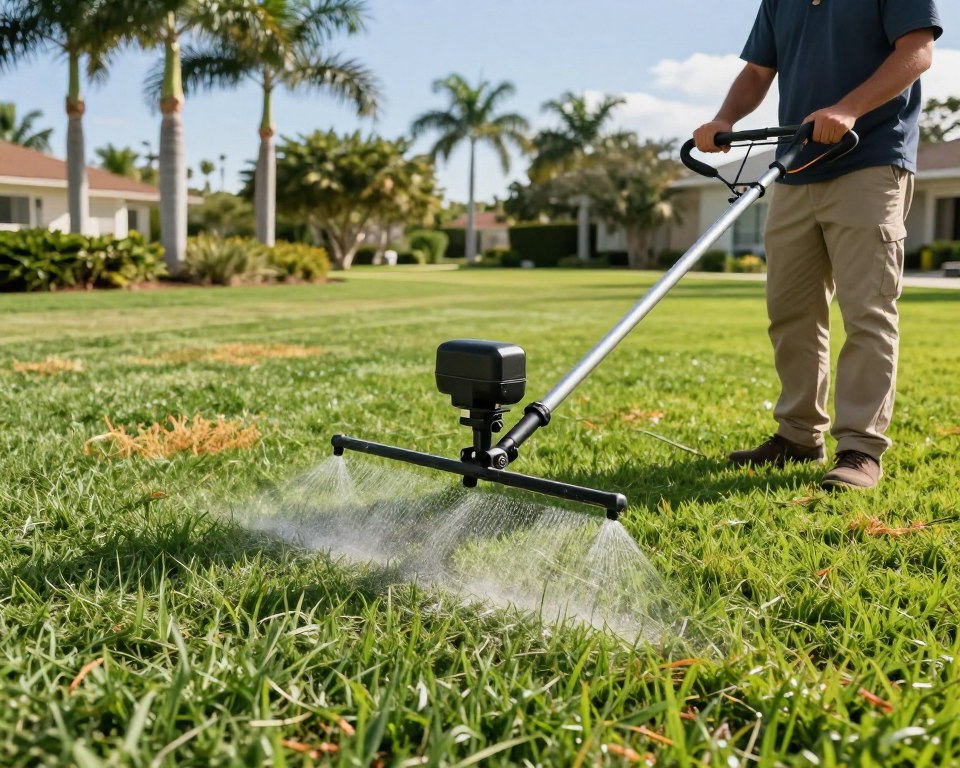
Use a broadcast spreader for uniform coverage
Pick a broadcast spreader for most yards. Walk at a steady pace and set the dial per the label.
Slightly overlap passes and avoid stopping over one spot. Put a deflector shield near hard surfaces to prevent granules on pavement.
Water after application to move nutrients into soil
Light irrigation helps granules wash off blades and reach roots.
Target roughly ½ inch of water after spreading. That amount moistens soil and cuts surface tracking without runoff if rain is not expected.
Delay mowing and avoid early tracking
Wait at least 24 hours before cutting grass. This lets granules settle and lowers the risk of spreading product onto sidewalks or into drains.
Care for newly planted turf
Hold off feeding new sod or seed for 30–60 days. Young roots need time to establish before added nutrients encourage weak top growth.
- Even coverage prevents stripes and burn caused by overlap or uneven speed.
- Watering moves fertilizer into soil and reduces surface loss.
- Delaying mowing protects sidewalks and improves uptake.
- Waiting after planting supports stronger root development and steadier growth.
| Action | Why it matters | Best result |
|---|---|---|
| Broadcast spreader, steady pace | Prevents concentrated passes and missed strips | Uniform color and fewer burn spots |
| Light irrigation (~½ inch) | Moves granules off blades into soil | Better uptake, less surface runoff |
| Delay mowing 24 hours | Allows product to settle and reduces tracking | Cleaner edges and protected drains |
| Wait 30–60 days after planting | Supports root establishment before heavy feeding | Stronger turf with steady growth |
Weather, ordinances, and runoff protection for Florida fertilization
Combine forecast checks and local rules before any application. Weather and regulations shape safe nutrient use. Heavy rain can move fertilizer off turf and into drains before grass can use nutrients.
Quick safety rules
- 24-hour rule: skip any spread if heavy rain is likely within the next day.
- Check local ordinances with the Florida Fertilizer Ordinances web app and follow county guidance.
- Keep a 10-foot unfertilized buffer next to canals, ponds, and drainage ditches.
- Use a spreader deflector shield and avoid applying product onto sidewalks or driveways.
- Sweep up any spilled granules; do not rinse them into streets or storm drains.
- Consider professional lawn help when rules are unclear, runoff risk is high, or a soil test calls for a calibrated plan.
| Issue | Recommended action | Benefit |
|---|---|---|
| Forecasted heavy rain | Delay application 24 hours | Less nutrient loss |
| Near waterbodies | Leave 10-ft buffer and use shield | Protects waterways |
| Spill on pavement | Sweep and dispose properly | Prevents drainage pollution |
Conclusion
Aim for active growth, not a fixed date, when planning your next feed. The best time aligns with spring green-up and the late-spring window for many yards. Use the simple fertilization schedule framework and pause in mid-summer if heavy rains are likely.
Match care to grass type. Higher-demand grass needs more frequent feeds. Low-input species need less. Pick slow-release nitrogen when possible and follow the UF/IFAS 1 lb N per 1,000 sq ft limit.
Do these basics: measure your area, get a soil test, and check weather and local ordinances via the Florida Fertilizer Ordinances web app. Then pick the next appropriate window, apply carefully, and water lightly so nutrients reach roots without runoff.
FAQ
When is the best time to start fertilizing a warm-season yard in South Florida?
How should rainfall patterns affect my fertilization schedule?
Is there a simple seasonal schedule for routine care?
How should the grass species affect timing and rates?
Why is soil testing recommended before applying nutrients?
How do I choose between slow-release and fast-release fertilizers?
What N-P-K ratio should I look for on a bag?
How much nitrogen is safe per application?
What are best practices for applying fertilizer?
What local rules and safeguards should homeowners follow?


