
 0
0
 0
0 Alligator Nesting Season in Florida brings a clear rhythm to ponds and marsh edges, and you should adjust outdoor plans accordingly. You’ll notice more movement as courtship starts in early April and mating follows in May–June, so give shorelines extra space.
Expect nests to appear in late June to early July, with females guarding clutches of roughly 32–46 eggs. Incubation runs about 60–68 days, so hatchlings often show up in late August to early September.
Practical tips: use daylight for water activities, avoid vegetation mats and shaded banks where gators rest, and assume presence near fresh or brackish water in this state. Keep pets leashed, stow fish scraps, and stay a safe distance from marsh edges.
If you encounter a 4‑foot or larger animal acting threatening, report it to the proper hotline rather than handling it yourself. A little awareness during this time keeps people and wildlife safer while you enjoy the outdoors.
Key Takeaways
- Courtship begins in April; mating peaks in May–June.
- Nests form late June–early July; expect hatchlings late Aug–early Sept.
- Assume presence near most fresh and brackish water areas.
- Use daylight, keep distance from shorelines, and secure pets and food.
- Report threatening 4‑foot+ animals to the nuisance hotline; don’t intervene.
Florida alligator nesting season timeline
The mating season begins in spring and runs through summer. Plan outings around those peak dates so you can avoid high‑activity areas.
Mating season begins: early April to May–June
Courtship starts in early April. Mating activity climbs in May and June. You’ll hear more vocalizing and see increased movement along shorelines.
Late June to early July: nest building and eggs
Females create mound nests of soil and vegetation in late June to early July. They lay about 32–46 eggs. After eggs are laid, expect incubation to run roughly 60–68 days.
Incubation to hatchlings: late August to early September
Hatching usually falls in late August to early September. Hatchlings are about 6–8 inches in length and often stay near the female for up to two years.
- During may june, give wide berth to basking alligators and females near likely nest sites.
- Use the dates above to pick safer times and routes for water activities.
Why this season changes gator behavior and risk
You’ll see behavior change as heat and mating push many adults to move and defend territory.
Adults become territorial and guard prime basking and travel routes. Females near nests may stand their ground instead of slipping into the water.
Temperature and activity patterns
Alligators are most active between 82°–92°F. They hunt and patrol more at dusk and night. Warmer days raise metabolism and increase movement.
- Avoid low light near shorelines; visibility drops at dusk.
- Expect more crossings between ponds and canals as gators move to mate and find nest sites.
- Keep clear sightlines and give space when you see fixed staring or hissing.
- Anglers: land fish quickly and never leave scraps that attract attention from nearby fish-eating adults.
| Factor | Effect | What you should do |
|---|---|---|
| High heat (82°–92°) | More movement and hunting | Use daylight hours; watch edges |
| Dusk and night | Peak activity | Avoid low-light water access |
| Females near young | May defend territory | Back away slowly; do not approach |
How to stay safe near water during mating and nesting
A few simple habits at dawn, dusk, and night cut risk and let you enjoy time near ponds and canals safely. Use clear routines and stay aware of signs that gators or alligators are nearby.
Smart habits at dawn, dusk, and night
Choose daylight for outings. Avoid low light when visibility drops and gators become more active. Supervise children closely near any pond, lake, canal, or marsh.
Swimming rules: use posted areas and daylight hours only
Only swim in designated areas with signs and lifeguards. Leave the water immediately if you see a gator or the situation feels off.
Fishing and fish-waste handling
- Land fish quickly; use a cooler instead of a stringer.
- Dispose of fish scraps in a trash can at the ramp, not in the water.
- Never feed a nuisance alligator; feeding is illegal and dangerous.
Keep pets on leash and away from the water’s edge
Keep pets leashed and away from the shoreline. Do not let pets swim or drink where gators congregate. Barking and splashing can attract attention.
| Action | Why | Quick tip |
|---|---|---|
| Stay in daylight | Better visibility; lower gator activity | Plan swims noon–late afternoon |
| Use posted areas | Monitored and safer for people | Follow signs and lifeguard guidance |
| Secure fish waste | Removes food attractants | Trash scraps at the ramp |
Recognizing nests, warning signs, and when to back away
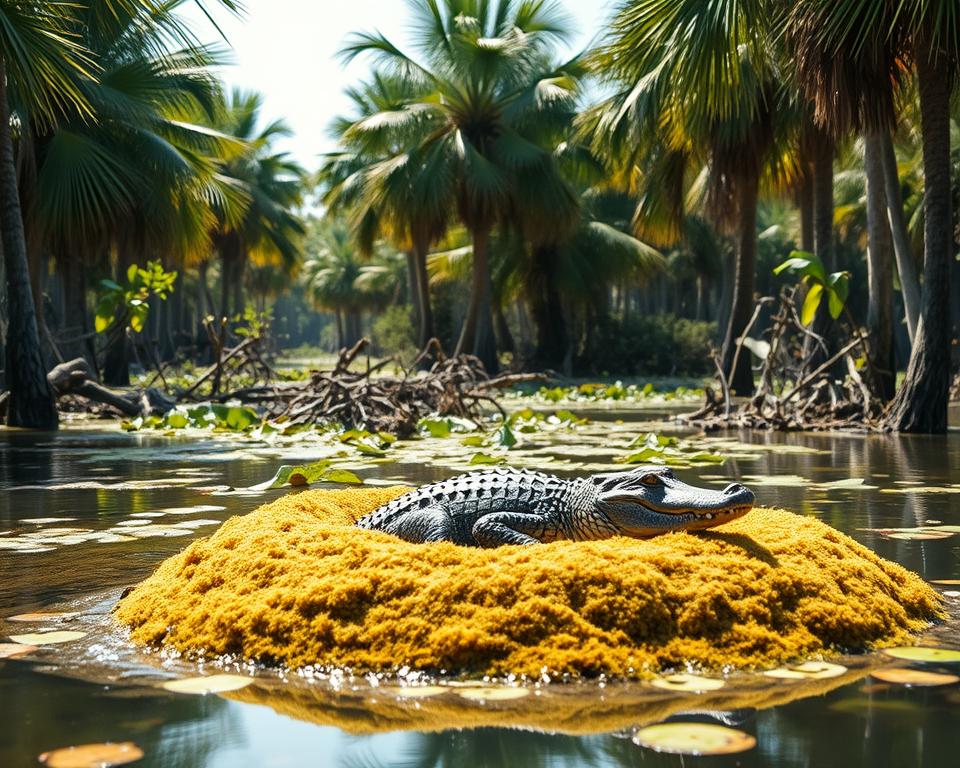
A dome of vegetation and soil on slightly raised ground is a common sign of a nearby nest. These mounds are usually near water and get plenty of sun.
What nests look like and where you’ll find them
Look for mound-shaped piles of plants, soil, and debris on higher ground beside ponds or marsh edges. Paths between the mound and shore may be trampled from travel.
During the nesting window, treat any fresh mound as active. Do not approach to check for eggs or to look inside.
Signals of agitation and clear retreat steps
Warning cues are obvious: an alligator turns its head to face you, lifts its body, hisses, or opens its mouth. These actions mean give space.
- Back away slowly the same route you came; avoid running through brush.
- If you spot small alligators, assume a guarding female is nearby and increase distance.
- Keep dogs well away and use binoculars for a distant look, not a closer approach.
| Sign | Action | Why |
|---|---|---|
| Dome-shaped mound | Detour wide | May contain eggs |
| Hissing/open mouth | Retreat slowly | Defensive behavior |
| Multiple young | Give extra space | Female likely nearby |
If an encounter escalates: bites, defense, and medical care
If an encounter intensifies, move fast and use loud, clear signals to break the animal’s focus. Create distance and keep a solid barrier—kayak hulls, boards, or shoreline gear work well.
Immediate actions if approached
- Put distance between you and the animal. Back away along a clear path; avoid cornering yourself near water.
- Make noise. Bang a paddle, clap, or shout to interrupt approach—do not toss fish or scraps.
- Do not feed. Feeding trains bold behavior and draws gators toward humans and pets.
If a bite occurs: fight and seek care
Fight back hard. Aim strikes at the snout and the eyes. Prevent rolling; use weight shifts and kicking to escape.
Once free, get out of the water, stop bleeding, and call emergency services. Seek professional care—bites often need antibiotics and wound management.
Risk reality: context and numbers
Serious unprovoked incidents average about eight per year (2012–2022). From 1948–2022 there were 453 unprovoked incidents and 26 fatalities. Lifetime risk of serious injury is roughly 1 in 3.1 million.
| Situation | Immediate step | Why it matters |
|---|---|---|
| Approach near kayak/board | Keep craft between you and animal | Creates a physical barrier, buys time |
| Close-range advance | Make loud noise; back away | Breaks approach pattern linked to feeding |
| Actual bite | Strike snout and eyes; escape; seek care | Quick, aggressive resistance improves survival |
Legal and reporting basics: FWC, nuisance alligator hotline, and rules
Public safety starts with accurate reports. When you see an alligator 4 feet or longer that threatens people, pets, or property, report it right away. Give the exact location, nearest access point, estimated length, and recent behavior.
When to call FWC: 1-866-FWC-GATOR
Call 1-866-FWC-GATOR (392‑4286) for any alligator that poses a threat. The FWC Statewide Nuisance Alligator Program (SNAP) dispatches licensed trappers to assess and remove problem animals in developed or high‑use areas.
Wildlife conservation commission guidance and control programs
The wildlife conservation commission and conservation commission programs balance public safety and wildlife conservation. The federal similarity listing lets the state use approved control and removal methods under strict rules.
Feeding and harassment laws you need to know
- Feeding or enticing an alligator is illegal and creates dangerous behavior.
- Don’t attempt capture or relocation; it’s unsafe and often unlawful.
- Report measurements and patterns—length in feet, times seen, and nearby attractants.
| Action | What to give | Why it matters |
|---|---|---|
| Call FWC | Exact location, length, behavior | SNAP targets removals where people are at risk |
| Reduce attractants | Secure trash, manage fish waste | Prevents nuisance alligator behavior |
| Follow rules | Use permits for legal take | Protects wildlife while keeping people safe |
Alligator life cycle and survival: what happens to eggs and hatchlings
Hatching is only the first hurdle: most eggs and young face heavy losses from predators, flooding, and competition. A successful clutch averages about 32–46 eggs, but many nests are destroyed before hatch day.
Clutch size, predation, flooding, and cannibalism impacts
About one‑third of nests are lost to raccoons, storms, or rising water. For surviving nests, roughly 24 live hatchlings emerge.
- Young are eaten by raccoons, otters, wading birds, fish (including florida fish predators), and larger alligators.
- Cannibalism by big individuals lowers juvenile survival and helps balance local numbers.
- Females build elevated mounds and pick sunny sites to cut flooding risk.
From eggs to adults: survival milestones across years
Survival drops quickly with age. From a successful nest, about 10 make it to one year, ~8 reach ~4 feet, and near 5 reach maturity at roughly 6 feet.
| Stage | Typical count | Why it matters |
|---|---|---|
| Hatchlings | ~24 | Most stay near the female for protection |
| 1 year | ~10 | Predation and habitat limit numbers |
| Adult (~6 feet) | ~5 | Few reach full size; population stabilizes |
Knowing these stages helps you predict where different age classes appear during alligator mating season and guides safer choices around water. Respect space—avoid approaching groups of young to reduce risk to both humans and wildlife conservation goals.
Conclusion
A clear plan — timing, distance, and pet control — makes time near ponds far safer.
Remember when the season begins: courtship in April, mating in May–June, nests in early July, and hatchlings late summer. Give space to mounds and young, and assume adults are nearby.
For safe fun, choose daylight swimming in posted spots, keep pets away from the water, and never feed wildlife. Secure fish scraps in a trash can to avoid creating a nuisance alligator problem.
If a gator threatens people or pets, call 1-866-FWC-GATOR for animals 4 feet or longer. Stay calm, back away, and keep a steady buffer. A little awareness makes every visit safer for you and the wildlife.
FAQ
When does mating activity typically begin and peak?
When do females build nests and lay eggs?
How long is incubation and when do hatchlings appear?
How long do young stay with the female?
Why does this time of year change behavior and risk levels?
What daily times are these reptiles most active?
What safety habits should I use near water now?
How should I handle fishing and bait to avoid attracting them?
What rules apply to pets near water?
What do nests look like and where are they found?
What warning signs mean I should back away immediately?
What should I do if one approaches me?
What if a bite occurs—what immediate steps should I take?
How common are unprovoked bites?
When should I contact the Wildlife Commission or nuisance hotline?
What services does the conservation commission provide?
Are there laws about feeding or harassing wildlife?
How many eggs are in a typical clutch and what threats do they face?
What are the main survival milestones from egg to adult?


